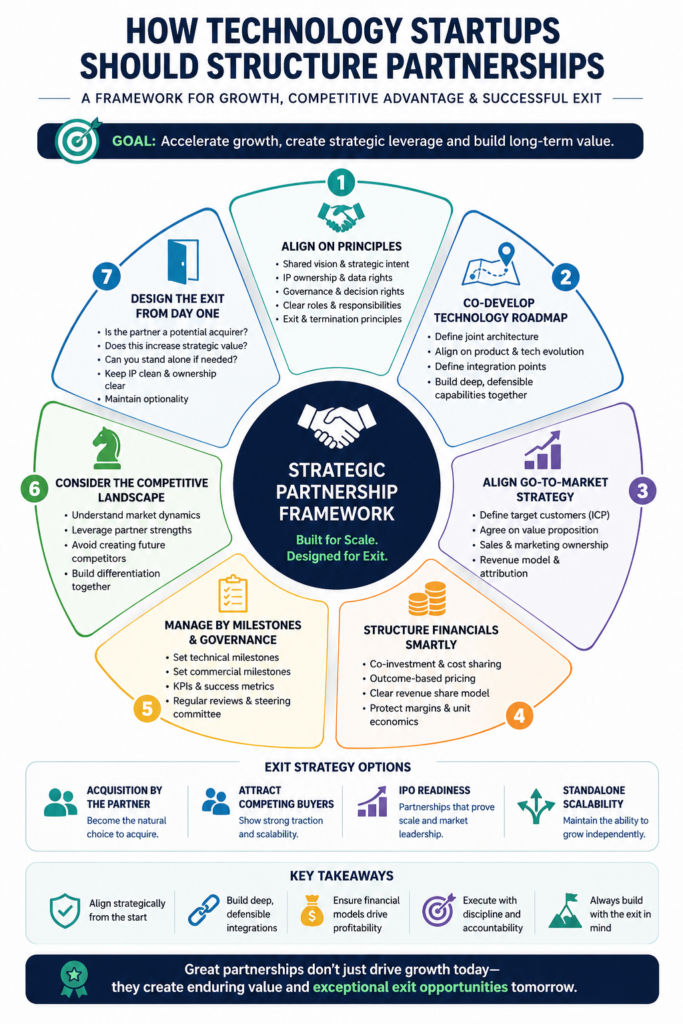

In 2026, partnerships are no longer tactical; they are core to scaling, competitiveness, and exit strategy. How you structure partnerships today directly impacts your valuation tomorrow.
1. Start with Principles
Align early on IP ownership, data rights, and governance. Acquirers value clean, defensible assets, not complex dependencies.
2. Co-Build the Technology Roadmap
Partnerships are now co-developed systems. Your goal: become a critical dependency, not a replaceable feature.
3. Align on GTM Execution
Define who sells, to whom, and how revenue is shared. Joint pipeline and traction signal scalability beyond founder-led growth.
4. Structure Financials Smartly
Use co-investment and outcome-based models. Ensure partnerships improve—not dilute—your unit economics.
5. Manage Through Milestones
Set technical and commercial targets, with regular governance. Execution discipline turns partnerships into growth engines.
6. Think Competitive Positioning
Partnerships can lock ecosystems or limit you. Be clear: are you gaining leverage or reinforcing a larger player?
7. Design the Exit Early
Every partnership should create optionality:
Is the partner a future acquirer?
Does this increase your strategic value?
Can you still stand alone?
Avoid restrictive exclusivity and unclear IP structures.
In summary:
The best partnerships don’t just drive growth; they strengthen independence, scalability, and exit potential.
Build partnerships that increase value—not complexity.
By: Sam Ahlin