

Expanding your investment portfolio beyond domestic borders is a vital strategy at this age, for mitigating risk and accessing untapped global economic opportunities. In an era characterized by fragmented trade and localized geopolitical shocks, relying solely on a domestic market is a critical vulnerability. By allocating capital across different regions, investors create a financial buffer: the downturn of one local economy can be offset by the prosperity of another.
Leading institutions like the World Economic Forum and UNCTAD recently highlighted that global markets have entered a period of “structural volatility,” making cross-border diversification not just an option, but a necessity for asset preservation.
Key Market Distinctions When venturing into global markets, it is crucial to understand the difference between the two primary categories:
- Developed Markets: These offer stable infrastructures, mature economic systems, and a sense of security, though they generally feature lower growth rates.
- Emerging Markets: These regions boast rapid economic development and high innovation. They promise the allure of higher returns but come with increased volatility risk, a lack of a strong legal framework, and market unpredictability.
Execution: Steps to Start Investing Globally. We outline three critical steps for international expansion:
- Identify Investment Goals: Define your purpose, whether it is ROI (portfolio growth), income generation (dividend income), or hedging against domestic volatility.
- Research International Markets: Use comprehensive analytics to decode global finance, evaluating countries based on economic indicators (GDP growth, unemployment, inflation), political stability, and sector strengths (e.g., sustainable energy, tech, manufacturing). Additionally, include your actual needs and wants, and keep an eye on politics, culture, and people.
- Select the Right Platform: Choose an investment platform that bridges your strategic vision with the necessary technological and regulatory frameworks. Moreover, you need to understand your risk tolerance and appetite.
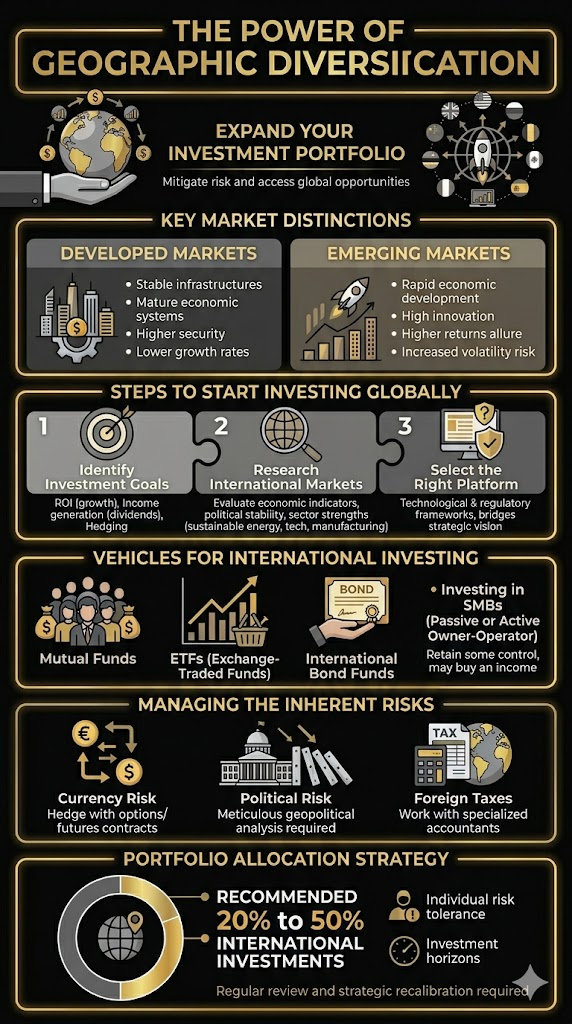
Asset Vehicles and the Business Brokerage Advantage. Investors can access overseas markets through various vehicles: Mutual Funds, ETFs (Exchange-Traded Funds), and International Bond Funds. Each come with a risk and reward profile, but they are not immune for financial global crisis, and you have little control on their future performance.
For those seeking to actively shield their wealth from broad market sell-offs, private enterprise offers a superior alternative. Investing in SMBs either as a passive or active owner-operator, especially in a market vertical in which you have some experience, this way you retain some control and may be buying an income for this engagement. Securing operational stakes in robust foreign SMEs provides localized cash flow that is highly insulated from macroeconomic paper-market volatility.
Managing the Inherent Risks Global investing introduces specific challenges that must be actively managed:
- Currency Risk: Fluctuating exchange rates can erode returns. The article suggests using options and futures contracts to hedge against this volatility.
- Political Risk: Shifts in governance and policy can impact financial stability. Meticulous geopolitical analysis is required.
- Foreign Taxes: Diverse tax jurisdictions present a maze of regulations. Working with specialized accountants ensures optimal profitability and tax compliance.
Portfolio Allocation Strategy. There is no one-size-fits-all formula, but financial advisors generally recommend allocating 20% to 50% of a portfolio to international investments. This range depends on individual risk tolerance and investment horizons. We stress that integrating international assets with domestic ones requires regular review and strategic recalibration to adapt to the ever-changing global economic landscape.
By: Sam Ahlin