

Maxloyal

Dual Strategies for Small Business Acquisition Evaluation: Turnaround Investor vs. Operating Investor

Acquiring a small, founder-managed business requires a due diligence and valuation approach tailored entirely to the investor’s end goal. Maxloyal defines two distinct acquisition frameworks: one engineered for rapid return on investment (ROI), which is suitable for a short-term investor who plans to buy, improve, & sell, and another designed for a secure, long-term investor-operator who buys a business to run for a sustained monthly income.

Here is the breakdown of the two primary strategies.

Strategy 1: The Turnaround Investor (Short-Term ROI)

The “Buy, Improve, Sell” Model

This aggressive strategy is designed for investors looking to extract maximum value in a short period by acquiring underperforming assets, modernizing them, and selling them at a premium.

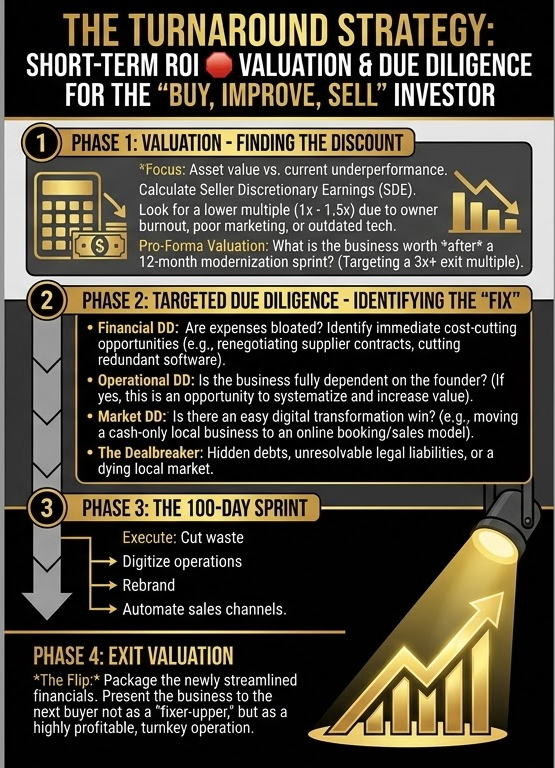
  • Phase 1: Valuation – Finding the Discount

The focus here is on the gap between the asset’s current state and its true potential. Valuation centers on calculating the Seller Discretionary Earnings (SDE) but actively seeking a discounted purchase multiple (1.5x – 2.5x SDE). This discount is typically secured by targeting businesses suffering from owner burnout, outdated technology, or poor marketing. The goal is to build a pro-forma valuation: what will this business be worth after a 12-month modernization sprint?

  • Phase 2: Targeted Due Diligence – Identifying the “Fix”

Due diligence is highly targeted toward finding immediate, actionable improvements. Financially, investigators look for bloated expenses that can be immediately cut (redundant software, poor supplier terms). Operationally, they assess if the business is overly dependent on the founder—if so, systematizing the operations will instantly increase its resale value. The main dealbreakers are hidden debts or a dying local market.

  • Phase 3: The 100-Day Sprint

Execution is fast and ruthless. The immediate post-acquisition phase involves cutting waste, digitizing cash-only operations, rebranding the storefront, and automating sales channels.

  • Phase 4: Exit Valuation

The newly streamlined financials are packaged for resale. The business is presented to the next buyer not as a “fixer-upper,” but as a highly profitable, turnkey operation, aiming for a 4x or higher exit multiple.
Strategy 2: The Buyer-Operator (Long-Term Income)

The “Buy, Restructure, & Operate” Model

This steady, thorough strategy is built for owner-operators utilizing the business acquisition to facilitate their relocation, secure residency (such as a soft-landing in Spain), and generate reliable dividends.

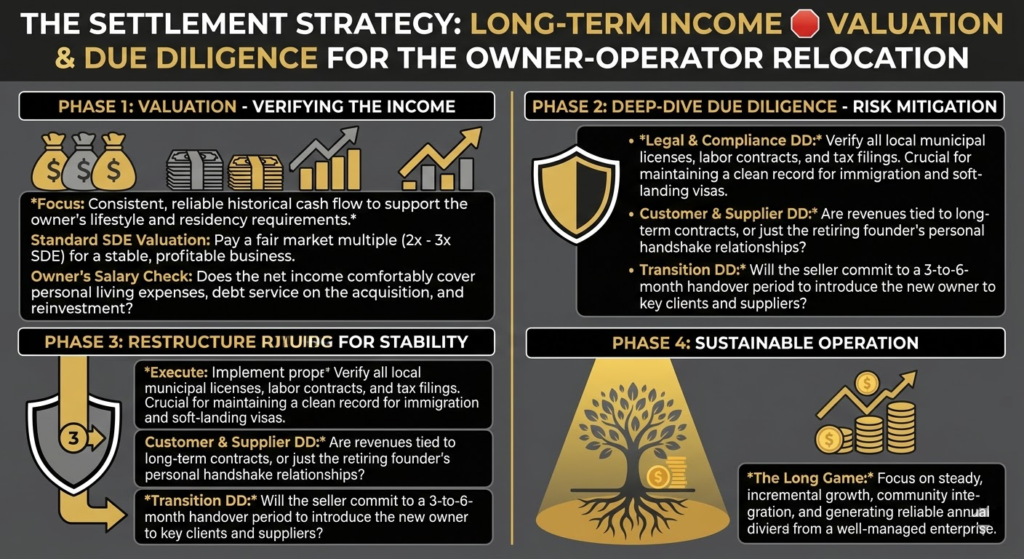
  • Phase 1: Valuation – Verifying the Income

The priority is a consistent, reliable historical cash flow that can comfortably support the new owner’s lifestyle and residency requirements. Investors typically pay a fair market multiple (2x – 3x SDE) for a stable, profitable business. The critical “Owner’s Salary Check” ensures the net income covers personal living expenses, debt service on the acquisition, and future reinvestment.

  • Phase 2: Deep-Dive Due Diligence – Risk Mitigation

Due diligence here is exhaustive and defensive. Legal and compliance checks are paramount; all municipal licenses, labor contracts, and tax filings must be flawless to maintain a clean record for immigration visas. Furthermore, investigators deeply analyze customer and supplier concentration to ensure revenues are tied to long-term contracts, rather than just the retiring founder’s personal handshake relationships.

  • Phase 3: Restructure for Stability

Upon acquisition, the focus shifts to security rather than rapid disruption. The new owner implements proper corporate governance, secures employee retention through clear communication, and carefully transitions key vendor and client relationships to the new MPS-advised ownership structure. A legally binding 3-to-6-month handover period with the seller is crucial here.

  • Phase 4: Sustainable Operation

The long game begins. The operator focuses on steady, incremental growth, deep community integration, and managing the enterprise to generate reliable, year-over-year income.

Scroll to Top

Listing the Unlisted (Whisper List)

What it delivers: discreet access to off-market opportunities with controlled, trust-based introductions.

  • Confidential deal discovery: We surface off-market businesses and assets that won’t appear on public marketplaces, reducing bidding wars and noise.
  • Controlled introductions: We only connect parties after fit is confirmed—vetted buyer, NDA, and clear engagement rules—so owners stay protected.
  • Clean qualification process: Buyers receive a structured teaser + key facts first; only serious parties move forward to deeper information.
  • Deal execution support (when matched): If a match proceeds, we support M&A due diligence coordination (commercial logic, risk flags, documentation checklist, stakeholder alignment) to reduce surprises.

Joint Venture Partnering & Structuring

What it delivers: the right partner, aligned incentives, and a governance structure that prevents JV failure.

  • Partner identification & vetting: We find partners that match your strategic intent (capability, footprint, market access, culture, ethics) and screen for red flags early.
  • Alignment before paperwork: We facilitate structured alignment on value contribution, roles, decision rights, profit-sharing logic, and “non-negotiables” before lawyers draft.
  • Governance that reduces risk: We shape a practical JV operating model—steering committee setup, KPIs, escalation paths, IP boundaries, exit triggers—so the JV doesn’t collapse under ambiguity.
  • Investment readiness & partnerships: We help you package your proposition for strategic partners (why this JV, why now, what’s in it for both sides) and strengthen credibility.

Small Investment Opportunities

What it delivers: curated, smaller-ticket opportunities with decision support—so investors act with clarity, not hype.

  • Curated deal flow (smaller tickets): We shortlist opportunities suitable for smaller investors, based on fit, realism, and execution feasibility—not marketing narratives.
  • Structured screening: We apply a consistent lens (business model clarity, unit economics, defensibility, operator capability, regulatory exposure, market timing) to filter out weak opportunities.
  • Matchmaking with intent: We connect investors to opportunities where expectations match—risk tolerance, timeline, involvement level, and return profile.
  • Decision support & navigation: We provide options framing (best case / base / downside), key risks, and go/no-go support so investors can decide with confidence.

Market Expansion Opportunities

What it delivers: a practical expansion path—where to enter, how to win, and how to reduce time/cost/risk.

  • Expansion Logic & Readiness (ELR): A fast diagnostic that confirms whether expansion makes sense now, what must be true, and the readiness gaps to fix first (offer, delivery, capacity, credibility).
  • Market Maturity Review (MMR): A structured comparison of target markets—demand readiness, buyer behavior, channel access, competition intensity, risk, and entry complexity—so you choose the best market first.
  • Market entry strategy & representation: We translate analysis into action—market entry plan, partner/channel approach, outreach narrative, and support to build early traction.
  • Lower-risk execution: We help you avoid the common expansion traps: wrong segment, wrong channel, underpriced offer, unclear differentiation, and operational overstretch.

Logistics & Residency Assistance

What it delivers: smoother relocation and faster settling—so investors and leadership can focus on execution, not paperwork.

  • Visa/residency guidance coordination: We support navigation of the process with trusted coordination (requirements, documentation path, timelines, local steps)—without leaving you to guess.
  • Relocation planning for leadership/investors: We help structure the move: scheduling, priority checklist, key services setup, and local dependencies so relocation doesn’t delay business.
  • Settlement coordination: Practical support for landing and establishing—housing coordination, basic setup guidance, and local onboarding steps for a faster “operational start.”
  • Business continuity focus: The goal is reducing friction and downtime during the transition—so the expansion project doesn’t lose momentum.