

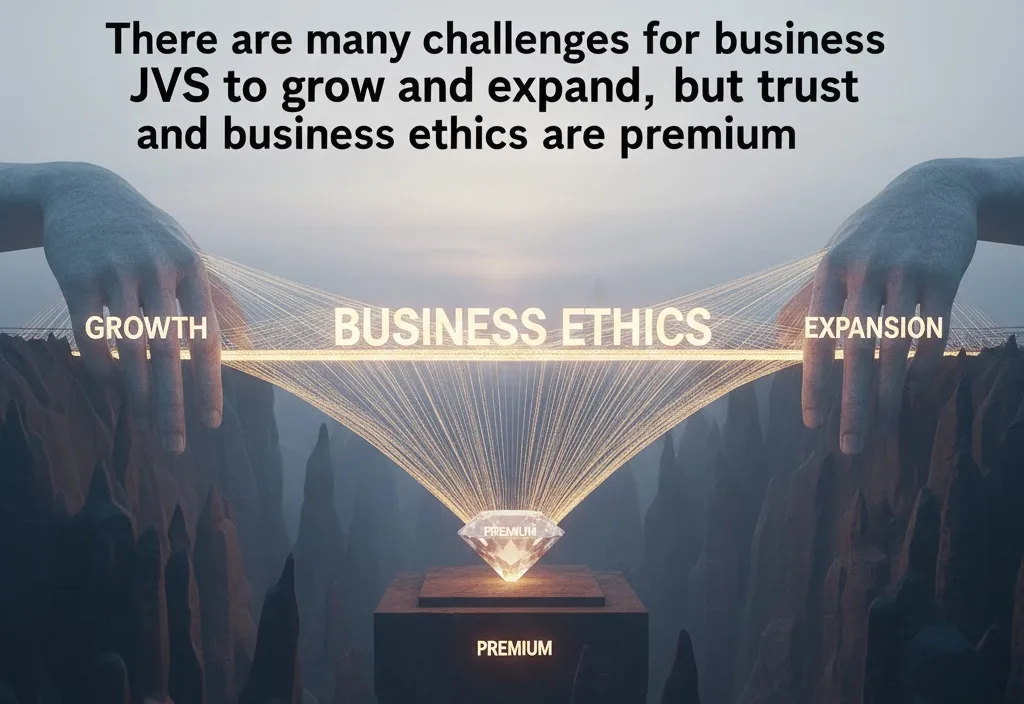
Small-business joint ventures (JVs) are often built to solve hard problems fast—entering a new market, accessing distribution, sharing capital, or scaling operations. But the same forces that make JVs attractive also make them fragile: limited resources, unclear roles, and high dependence on a small number of people. That’s why many experts treat trust and business ethics not as “soft” topics, but as core infrastructure for JV survival.
Research and practitioner evidence consistently shows that alliances and JVs fail at high rates, often because partners underestimate relationship dynamics and overestimate the power of contracts. Harvard Business Review has long highlighted that alliance failure rates can be very high (often cited in the 60–70% range), even while alliances represent a large share of revenue and value for many companies. (Harvard Business Review)
Why trust is a premium in small-business JVs
A JV is not just a legal structure; it’s a shared operating system. In the early months, decisions are frequent, information is incomplete, and partners must act before certainty exists. In that environment, trust becomes a performance multiplier because it reduces “friction costs”—time spent defending positions, over-controlling, and second-guessing motives.
Academic work on strategic alliances emphasizes that trust, control, and risk are tightly linked: the less you trust, the more you must control—and the higher your coordination cost becomes. (SAGE Journals) This isn’t a moral argument; it’s economic. When trust is high, partners spend less energy protecting themselves and more energy building value. (Harvard Business Review)
The three trust tests that matter most in early JV life
For small JVs, “trust” is not one thing. It usually shows up in three forms—each tied to your thesis points:
1) Trust in intentions: control, decisions, and motives
Early-stage JVs are highly exposed to “hidden agendas”: one partner using the JV to learn, stall a competitor, shift risk, or extract know-how. Alliance research describes opportunism, monitoring complexity, and coordination conflict as common pathways to instability and termination. (JSTOR)
Practical implication: In the first year, governance must be explicit: who decides what, how budgets are approved, what requires joint sign-off, and what happens in a deadlock. Research on JV management control shows that control design is a real determinant of how the relationship functions in practice (not just on paper). (ScienceDirect)
2) Trust in honesty: transparency and “truth-telling” under pressure
Small JVs break when information becomes asymmetric—one party sees pipeline, cash, customer complaints, or compliance risks and chooses not to disclose. Transparency is not just reporting; it’s early warning behavior.
This is where business ethics becomes measurable. Credible institutions like the OECD emphasize that business integrity strengthens market confidence and performance by promoting stronger internal controls, ethics, and compliance programs. (OECD) The OECD’s responsible business conduct guidance also explicitly includes joint venture partners within the scope of “business relationships” that require responsible governance and due diligence. (OECD)
Practical implication: Treat transparency as a system—monthly KPI dashboards, shared CRM visibility (where relevant), documented decisions, and audit trails for spending and procurement.
3) Trust in capability: skills, execution, and reliability
Many JVs don’t fail because partners are dishonest—they fail because one side cannot execute. Research on partner selection and alliance performance shows that partner fit and selection materially affect outcomes. (JSTOR) For small firms, this matters even more: there is less redundancy, fewer buffers, and fewer specialists to “patch” gaps.
Practical implication: Competence trust must be proven early via milestones: hiring the right operator, delivering the first customers, meeting regulatory requirements, and sustaining service quality.
“Most JVs fail due to lacking one or both partners”
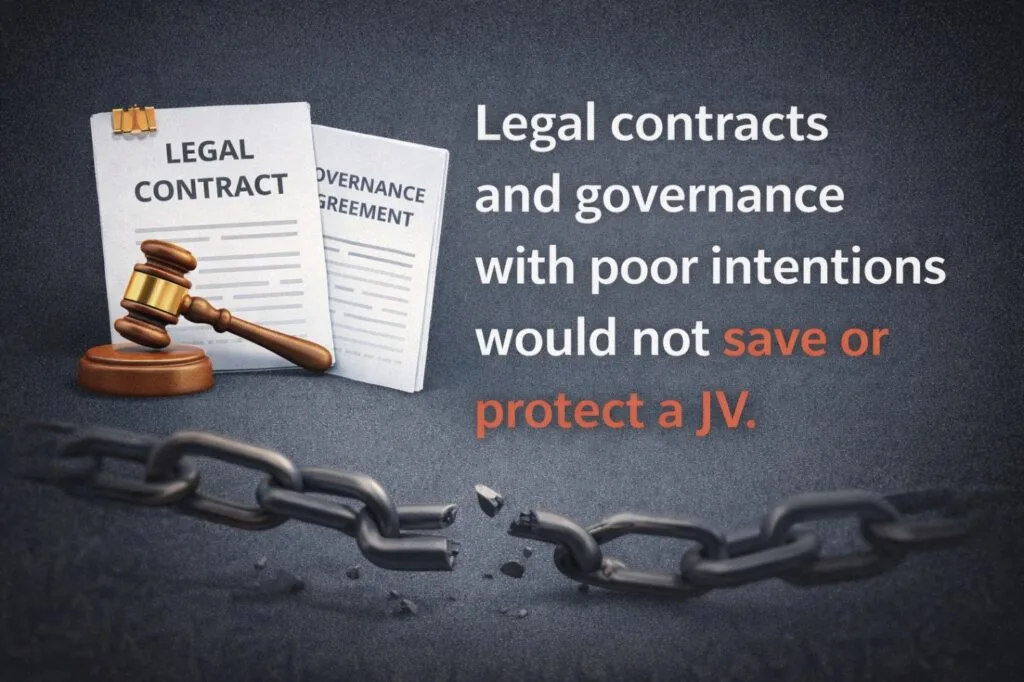
Your statement is directionally right, and the research backs the mechanisms behind it. Alliances often unravel due to a mix of opportunism risk, coordination difficulty, and strategic conflict—all of which become more dangerous when trust and ethics are weak. (JSTOR) What looks like a “market problem” is frequently a governance and integrity problem in disguise.
A practical trust-and-ethics playbook for small JVs
If you want trust to be real—not inspirational—build it into the JV design:
1) Put ethics into the operating model (not the brochure)
- Code of conduct and conflict-of-interest policy for both partners
- Partner due diligence checklist (especially if one partner is inexperienced)
UNODC’s practical guidance on ethics and compliance programs explicitly addresses business partners (including JVs) and emphasizes due diligence processes and red flags. (businessintegrity.unodc.org)
2) Design “trust with verification” governance
- Decision rights matrix (pricing, hiring, budgets, supplier changes, IP use)
- Monthly performance and cash review
- Right to audit material spending and key contracts
3) Make competence measurable
- 90-day and 180-day delivery milestones
- Training/certification gates before independence
- Customer satisfaction + service SLA reporting (especially for subscription models)
4) Align incentives
- Avoid a structure where one side does heavy lifting without fair upside
- Use clear commercial terms (management fee, royalty, margin structure) to prevent resentment-driven failure
Closing thought
For small business JVs, trust is not a personality trait—it’s a business asset. It reduces transaction costs, speeds decisions, and protects the relationship when the market gets hard. And business ethics isn’t “nice to have”—it is the operating discipline that keeps trust durable under stress. When both are treated as core design inputs, JVs can become one of the fastest, most capital-efficient ways for small companies to expand—without becoming one of the most expensive ways to fail.
By: Sam Ahlin