
Maxloyal

Doing Business in Sweden 2026 — Key Points at a Glance

Doing Business in Sweden 2026 — Key Points at a Glance

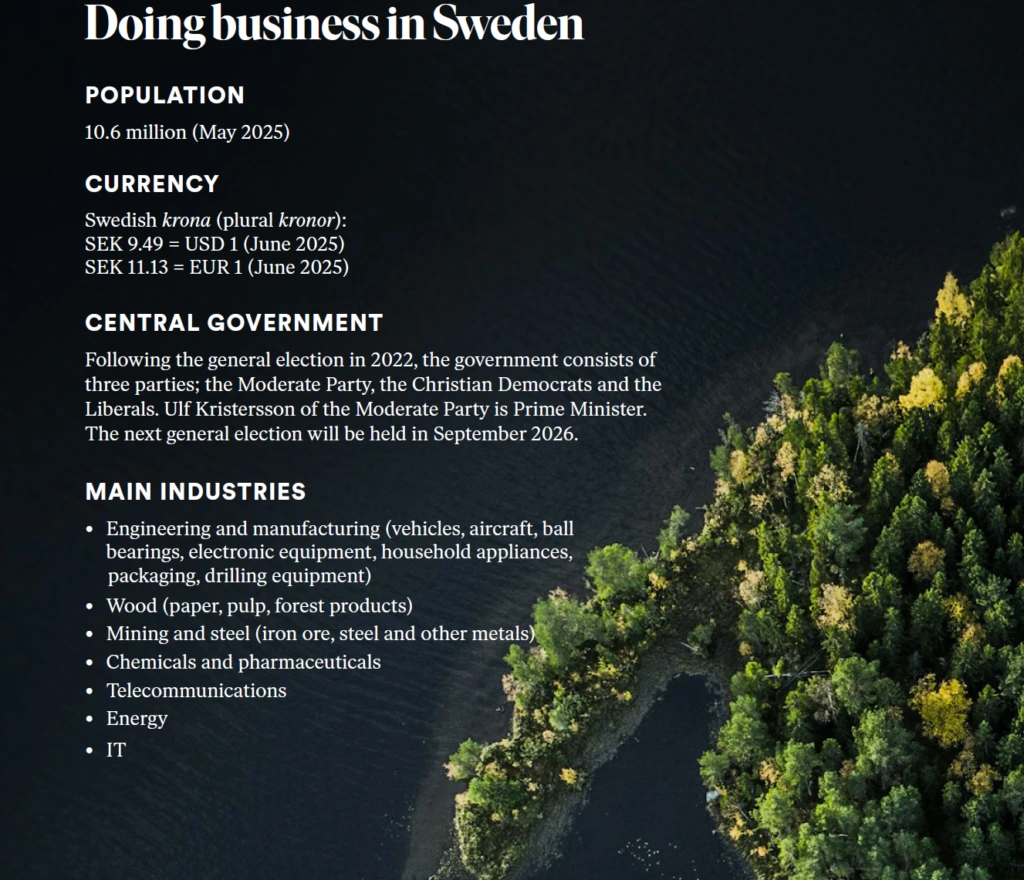
Sweden remains one of Europe’s most stable and attractive markets for doing business in 2025, offering EU market access, strong legal certainty, transparent governance, and a highly developed digital and innovation ecosystem. Foreign investment is generally encouraged, supported by competitive corporate taxation and robust protection of property and contractual rights. However, recent regulatory developments—particularly foreign direct investment screening, EU foreign subsidy rules, and competition oversight—mean that successful market entry now requires earlier planning and stronger compliance readiness. Sweden rewards long-term, well-governed businesses that align with its high standards in corporate governance, taxation, employment, and regulatory transparency.

Doing Business in Sweden 2025 — Key Points at a Glance

🇸🇪 Business & Investment Climate

  • EU member since 1995; EU law fully integrated into Swedish law
  • No exchange controls or currency restrictions
  • Foreign ownership generally unrestricted
  • Strong public institutions, political stability, and rule of law

🏛️ Legal & Regulatory Framework

  • Legal system based on statute law and case law
  • Signatory to major international conventions (including CISG)
  • Courts are efficient; arbitration is highly developed
  • Stockholm is a leading global arbitration venue

🌍 Foreign Investment & Control

  • Foreign investment encouraged, but FDI screening applies
  • Mandatory notification for investments in security-sensitive or strategic sectors
  • Applies regardless of investor nationality, including some intra-group transactions
  • Standstill obligation until approval is granted

🏢 Business Structures

  • Most common entity: Limited Liability Company (AB)
  • Minimum share capital:
    • Private AB: SEK 25,000
    • Public AB: SEK 500,000
  • Shareholders have limited liability
  • Clear rules on board duties, director liability, and governance

🤝 M&A and Competition

  • Private M&A largely contract-driven
  • Public takeovers subject to mandatory bid rules
  • Merger control applies if Swedish turnover thresholds are exceeded
  • Large transactions may also trigger EU Foreign Subsidies Regulation (FSR)

💼 Taxation

  • Corporate income tax: 20.6% (flat rate)
  • Participation exemption for qualifying dividends and capital gains
  • Loss carry-forward generally unlimited (subject to ownership rules)
  • Interest deductibility limited by EBITDA-based rules
  • Transfer pricing aligned with OECD arm’s-length principle

👩💼 Employment & Workforce

  • Employment regulated by law and collective bargaining agreements
  • Strong employee protections and union influence
  • Minimum 25 days paid annual leave
  • Employers pay approx. 31.4% social security contributions
  • Termination requires objective grounds and procedural compliance

🧠 Intellectual Property & Innovation

  • Strong protection for patents, trademarks, designs, copyrights, and trade secrets
  • IP framework fully aligned with EU regulations
  • Efficient enforcement through courts and authorities

⚖️ Dispute Resolution

  • Well-functioning court system with predictable outcomes
  • Arbitration awards widely enforceable under the New York Convention
  • Costs generally follow the outcome of litigation
Doing Business in Sweden 2026 — Key Points at a Glance

Want the Full Picture?

This summary highlights only the most critical considerations.
For detailed guidance on corporate structures, taxation, employment law, M&A, IP protection, and dispute resolution, read the full report:

👉 Doing Business in Sweden 2025 – Vinge
(Official publication by Advokatfirman Vinge KB)

You can read the full article at:

chrome-extension://efaidnbmnnnibpcajpcglclefindmkaj/https://www.vinge.se/media/3dwneynu/doing-business-in-sweden-2025.pdf

Scroll to Top

Listing the Unlisted (Whisper List)

What it delivers: discreet access to off-market opportunities with controlled, trust-based introductions.

  • Confidential deal discovery: We surface off-market businesses and assets that won’t appear on public marketplaces, reducing bidding wars and noise.
  • Controlled introductions: We only connect parties after fit is confirmed—vetted buyer, NDA, and clear engagement rules—so owners stay protected.
  • Clean qualification process: Buyers receive a structured teaser + key facts first; only serious parties move forward to deeper information.
  • Deal execution support (when matched): If a match proceeds, we support M&A due diligence coordination (commercial logic, risk flags, documentation checklist, stakeholder alignment) to reduce surprises.

Joint Venture Partnering & Structuring

What it delivers: the right partner, aligned incentives, and a governance structure that prevents JV failure.

  • Partner identification & vetting: We find partners that match your strategic intent (capability, footprint, market access, culture, ethics) and screen for red flags early.
  • Alignment before paperwork: We facilitate structured alignment on value contribution, roles, decision rights, profit-sharing logic, and “non-negotiables” before lawyers draft.
  • Governance that reduces risk: We shape a practical JV operating model—steering committee setup, KPIs, escalation paths, IP boundaries, exit triggers—so the JV doesn’t collapse under ambiguity.
  • Investment readiness & partnerships: We help you package your proposition for strategic partners (why this JV, why now, what’s in it for both sides) and strengthen credibility.

Small Investment Opportunities

What it delivers: curated, smaller-ticket opportunities with decision support—so investors act with clarity, not hype.

  • Curated deal flow (smaller tickets): We shortlist opportunities suitable for smaller investors, based on fit, realism, and execution feasibility—not marketing narratives.
  • Structured screening: We apply a consistent lens (business model clarity, unit economics, defensibility, operator capability, regulatory exposure, market timing) to filter out weak opportunities.
  • Matchmaking with intent: We connect investors to opportunities where expectations match—risk tolerance, timeline, involvement level, and return profile.
  • Decision support & navigation: We provide options framing (best case / base / downside), key risks, and go/no-go support so investors can decide with confidence.

Market Expansion Opportunities

What it delivers: a practical expansion path—where to enter, how to win, and how to reduce time/cost/risk.

  • Expansion Logic & Readiness (ELR): A fast diagnostic that confirms whether expansion makes sense now, what must be true, and the readiness gaps to fix first (offer, delivery, capacity, credibility).
  • Market Maturity Review (MMR): A structured comparison of target markets—demand readiness, buyer behavior, channel access, competition intensity, risk, and entry complexity—so you choose the best market first.
  • Market entry strategy & representation: We translate analysis into action—market entry plan, partner/channel approach, outreach narrative, and support to build early traction.
  • Lower-risk execution: We help you avoid the common expansion traps: wrong segment, wrong channel, underpriced offer, unclear differentiation, and operational overstretch.

Logistics & Residency Assistance

What it delivers: smoother relocation and faster settling—so investors and leadership can focus on execution, not paperwork.

  • Visa/residency guidance coordination: We support navigation of the process with trusted coordination (requirements, documentation path, timelines, local steps)—without leaving you to guess.
  • Relocation planning for leadership/investors: We help structure the move: scheduling, priority checklist, key services setup, and local dependencies so relocation doesn’t delay business.
  • Settlement coordination: Practical support for landing and establishing—housing coordination, basic setup guidance, and local onboarding steps for a faster “operational start.”
  • Business continuity focus: The goal is reducing friction and downtime during the transition—so the expansion project doesn’t lose momentum.