

Maxloyal Small Investor Services (50K–1M EUR)
When a family invests in relocating to Europe, the “best deal” is rarely the best choice. The right target is the one that can deliver (1) stable, provable income, (2) manageable operational load, and (3) a credible fit with the residency route you’re applying under (which varies a lot by country and by visa type).
Just as important: EU residency is not one single “EU visa.” Each country has its own rules, timelines, and minimums—and some classic “golden visa” pathways have been restricted or removed. For example, Spain ended its Golden Visa program effective 3 April 2025, so investors should plan with alternative routes in mind. (KPMG)
Two major investment types (pick the model before picking the business)
1) Direct investment (you own and operate)
Best when your goal is self-employment + clearer control.
Typical structures:
- Buying an existing small business (asset or share deal)
- Buying a majority stake with operational control
- Buying a business and hiring a manager (semi-passive)
Where it shines:
- You can show clear “economic activity” + income (useful for many residence routes that look at sustainability and means of support).
Where it fails:
- If the business is too owner-dependent (you can’t step away)
- If licensing or staffing risk is high (hospitality, regulated trades)
2) Indirect investment (JV or share buying)
Best when your goal is market entry with a local operator, or you want to reduce daily operational load.
Typical structures:
- JV with a local partner (you bring capital; partner runs operations)
- Minority share investment (with governance rights)
- Co-investment with another operator/investor
Where it shines:
- Faster ramp-up in local markets
- You can leverage a strong local operator
Where it fails:
- Ambiguity in roles, profit distribution, decision rights, and exits (this is where many small JVs break).

Investor categories (match the deal to the family, not the other way around)
A) Family Relocation Investor (stability-first)
Wants predictable cash flow, clean records, low surprises.
B) Operator-Owner (hands-on)
Wants control and the ability to improve margins through active management.
C) Semi-Passive Investor (manager-run)
Wants income with limited daily involvement—needs systems, reporting, and reliable staffing.
D) JV/Partner Investor (local execution)
Wants speed and local capability—must prioritize partner quality and governance.
E) Growth Investor (portfolio approach)
Wants diversification—often mixes one stable direct business with a smaller growth/JV bet.
Business types that often fit 50K–300K EUR in the EU
Here’s a broader shortlist (typical ranges vary by country, location, lease terms, and profitability):
Everyday consumer cash-flow (often direct investment)
- Restaurant/café / takeaway (best with strong systems)
- Retail shop, specialty shop (spice/nuts/coffee), gift shop
- Bakery / pastry concept, deli
- Dry cleaner / laundry / laundromat
- Barber / beauty salon
- Pet grooming/pet services
Mobility & local services (often direct or manager-run)
- Carwash/Detailing
- Car rental / small fleet operations
- Auto workshop (tire/repair/detailing) (watch licensing and staffing)
- Mobile service shop / electronics repair
Trade and B2B micro-SMEs (good for JV or “expertise-led” routes)
- Export/import micro-trader (distribution niches)
- Light manufacturing / packaging / small production
- Cleaning company (contract-based)
- IT VAR, MSP/IT support services
- Second Hand Store
Niche/regulated or asset-heavy (needs stricter diligence)
- Gas station, EV Charging (high compliance + contracts + margins matter)
- Fishing company (permits/quotas/contracts are critical)
Residency/visa planning: what small investors must know (2026 reality)
- There is no universal “EU investor visa.” You choose a country, then a route.
- Some “investment-only” routes have high minimums; others focus more on business activity, job creation, or entrepreneurship rather than a simple purchase.
- Spain: Spanish routes (entrepreneur, highly qualified, digital nomad, non-lucrative, etc., depending on profile). (KPMG)
- Countries that still publicize investment residence frameworks (examples of official thresholds/programs):
- Italy Investor Visa: €250k (innovative startup) / €500k (Italian company) / €2M (bonds) / €1M (philanthropy). (investorvisa.mise.gov.it)
- Portugal ARI (investment residence): official AIMA overview confirms ARI exists and includes minimum stay requirements (e.g., 7 days first year; 14 days subsequent periods), with qualifying investment types defined in law. (AIMA)
- Countries that still publicize investment residence frameworks (examples of official thresholds/programs):
Important: visa rules change. Always verify with a qualified immigration lawyer in the target country before committing capital.
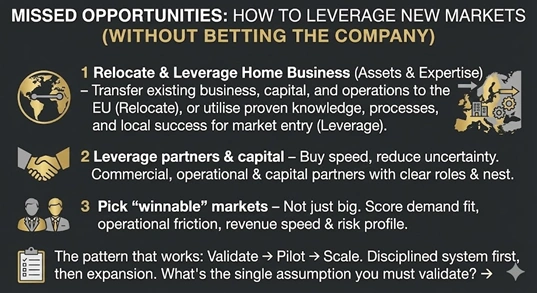
Added option: Transfer/relocate your existing home business to the EU
This is often overlooked—and for many families it’s the smartest path, because you’re not “starting from zero.”
1) “Asset relocation” model (you move operations)
- Set up an EU company (subsidiary/branch)
- Transfer equipment, inventory, and/or IP
- Recreate supply chain and customer acquisition locally
- Hire locally (where needed) and build tax-compliant operations
Best for: light manufacturing, trading/import-export, specialty retail, food brands, services with repeatable processes, especially niche business offering that is new to EU market.
2) “Expertise relocation” model (you move your proven know-how)
- You don’t move many assets—you move capability
- Build a local operation based on your track record:
- contracts, case studies, revenue history, certifications, client references
- Build a local operation based on your track record:
- Often pairs well with:
- local partner/JV
- acquisition of a small “platform business” in the same sector
- Often pairs well with:
Best for: IT services, consulting, training, B2B services, niche operations where credibility abd know-how matter more than capital and competition.
Why this helps residency planning: many entrepreneur/self-employment routes care about viability, income sustainability, and real economic activity. A proven business history can strengthen that story compared with a first-time purchase.
A simple decision framework for families (use this before you pick a deal)
- Choose your country first (lifestyle + schools + language + tax + residency route).
- Decide your involvement level (hands-on vs manager-run vs JV).
- Set income target + risk limits (base-case must support the family).
- Pick investment type: Direct vs JV/share vs Business transfer.
- Shortlist business types that match your involvement level and compliance tolerance.
- Do diligence that matches the risk:
- revenue proof, lease terms, staffing dependency, licensing, seasonality, supplier contracts
- Do diligence that matches the risk:
- Build a residency-aligned file: business plan, proof of funds/source of funds, insurance, compliance plan, and (where relevant) job creation and governance structure.
Contact Maxloyal for no obligation short consultation to explore your options.
By: Sam Ahlin